
Applications · Laser Cladding
Laser Cladding
Coating and repair with documented process quality, two families of processes under one roof.
Laser cladding is not a single process, but rather a family of processes with two fundamentally different operating modes.
High-Speed Laser Cladding (HSLC) is the process for production-ready coatings on rotating components.
Laser Metal Deposition (LMD) is the process for repair and structural build-up.
Both have their own fields of application, their own sweet spots, and their own limitations.
Process Monitoring during Cladding
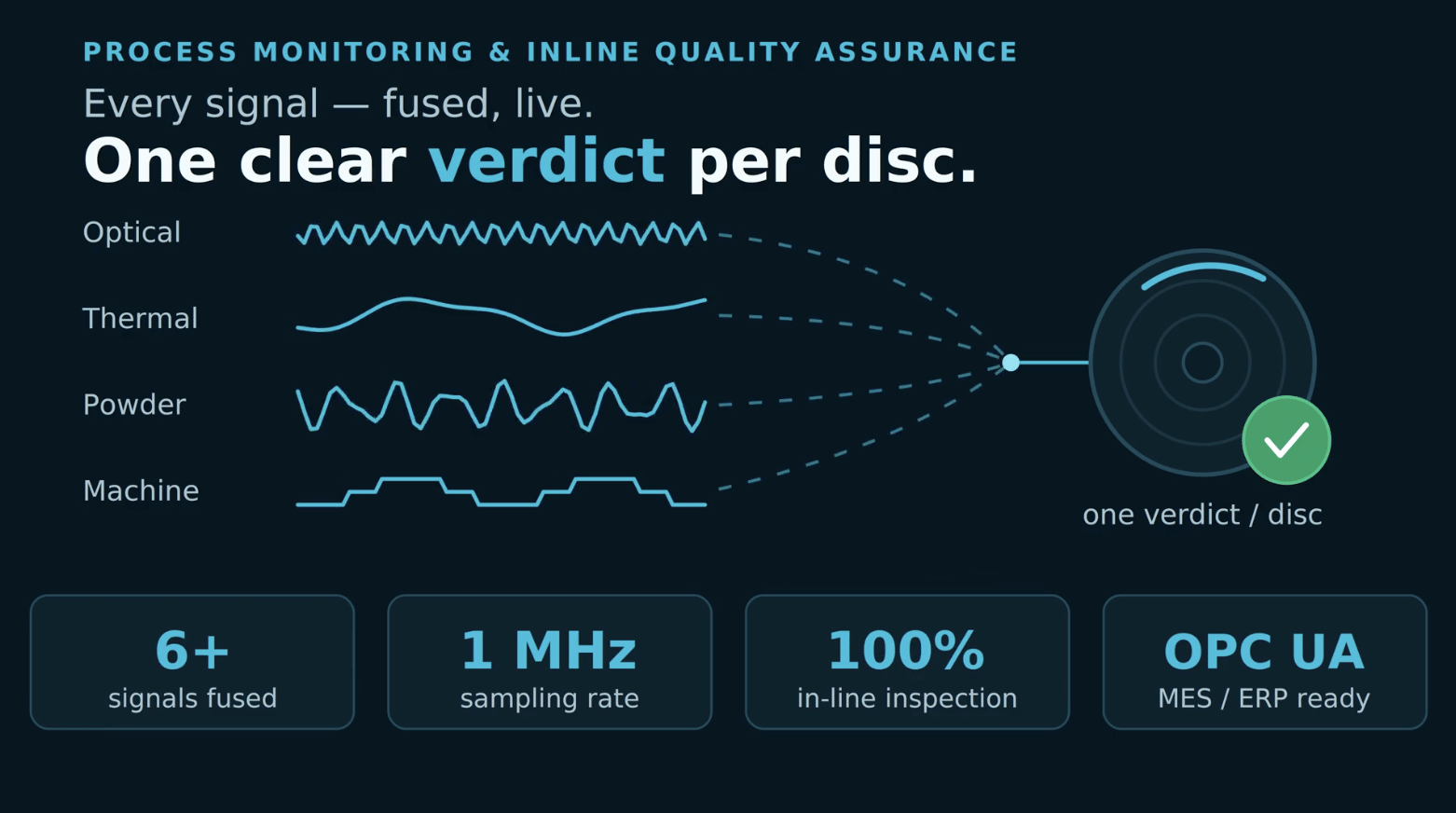
What PROMOS monitors and the errors it uncovers
PROMOS evaluates the cladding process in real time, rather than just the finished component: the melt pool, powder jet, shielding gas flow, and layer buildup are continuously compared against a digital reference profile for each component type—for both HSLC and LMD.
Defects we detect in the cladding process
connection defect
machine errors
micro pores
powder flow rate
trends & process drifts
difference in layer thickness
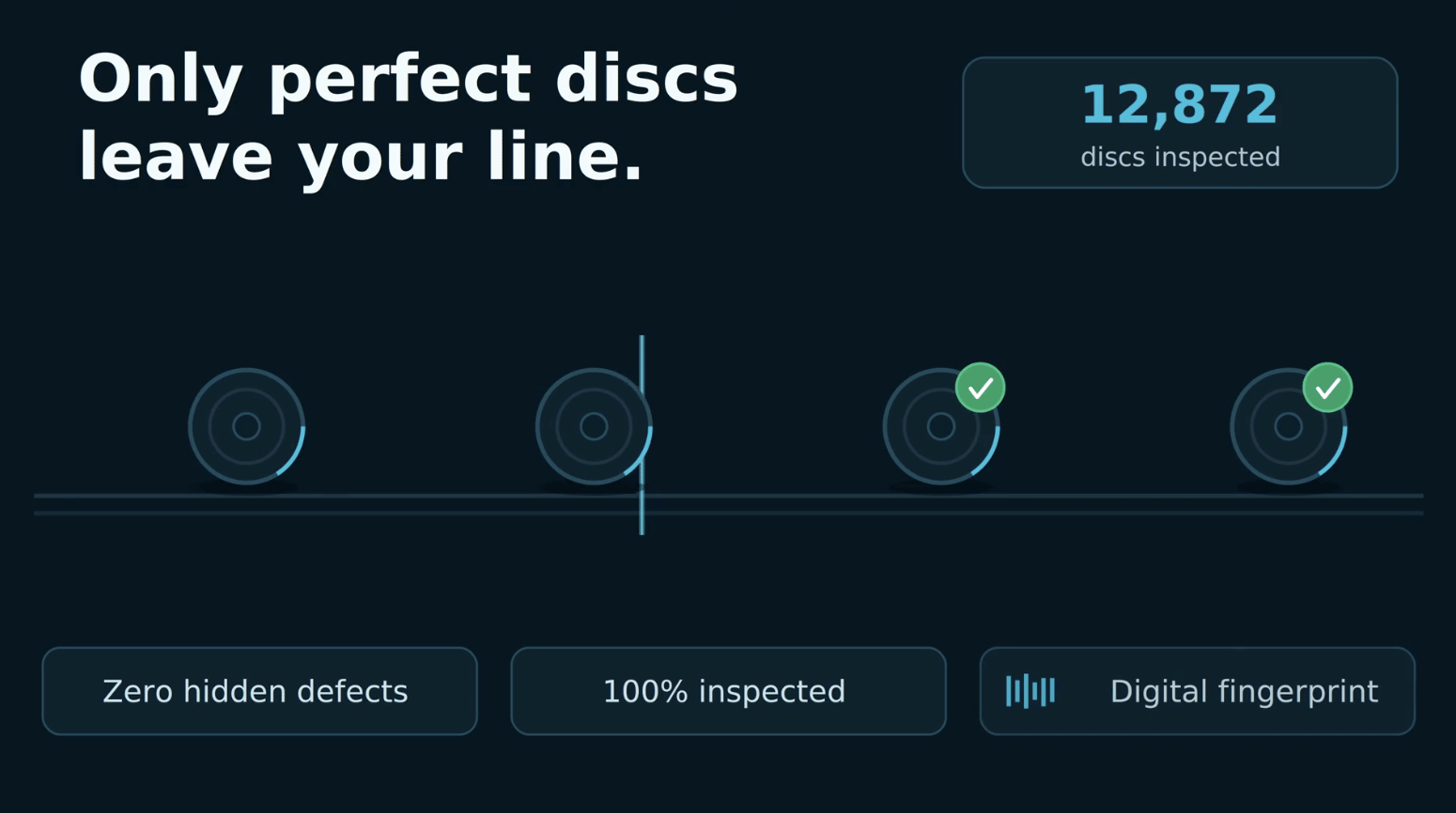
Why this counts: Brake discs are safety-critical components. Coating them requires more than just scrap reduction: 100% traceability and comprehensive documentation for every single disc.
The foundation for issuing targeted rather than blanket recalls in an emergency, and for avoiding the need for a recall altogether in normal circumstances.
Free initial assessment regarding your line
Free, no-obligation, approx. 45 minutes
What we deliver
Key reference: Brake disc cladding
The most prominent application for HSLC is the coating of brake discs, driven by Euro 7 and the new requirements regarding particulate matter emissions from brake systems.
In this context, weldmetrix supports several European brake disc manufacturers using a combination of WLDR sensor technology, LYRTH coating thickness measurement, and PROMOS as the analysis platform.
The two processes in detail
Two ways in
HSLC: High-Speed Laser Cladding
For serial coating with thin, stable layers on rotating components.
HSLC is the process that replaces conventional electroplating and hard chrome coatings in series production. High processing speeds (up to 400 m/min), very thin layers (typically under 300 µm), and minimal heat input make it the standard for components where reproducibility and cycle times are more important than geometric flexibility.
Typical application areas: brake discs, rollers and cylinders, shafts and axles, plain bearings, hydraulic and piston rods. Particular relevance: HSLC is the economically viable answer to the regulatory-driven replacement of electroplating processes (REACH, Chromium VI).
LMD/DED: Laser Metal Deposition
For repair, structural build-up, and near-net-shape manufacturing of complex components.
LMD is the process for tasks that HSLC cannot handle: repairing worn components, building up structures over a range of several millimeters, and processing parts with complex or three-dimensional geometries. The process speed is lower, the heat input is higher and more controlled, and the layer thickness is significantly greater.
Als DED-Verfahren nach ISO/ASTM 52900 ist LMD gleichzeitig Teil der Additive-Manufacturing-Welt. Das macht die Grenze zwischen Reparatur, endkonturnahem Aufbau und additiver Fertigung fließend: PROMOS bewertet alle drei Anwendungen mit derselben Plattform.
Discuss a specific repair case
Free, no-obligation, approx. 45 minutes
Process Differenciation
Comparison of procedures at a glance
Eight axes along which HSLC and LMD/DED differ systematically, ensuring that the choice of process is based on technical characteristics rather than preferences.
DIMENSION
Usecase
Process Speed
Layer thickness
Heat input
Geometrics
Serial size
AM Connection
Typical Components
HSLC
Production-ready coating
up to 400 m/min
below 300 µm
minimal
rotationssymmetrisch, einfach
High-Volume Series
no
Brake discs, rollers, cylinders, shafts, plain bearings
LMD / DED
Repair & Structure
slower, depends on geometry
multiple hundred µm
higher, controlled
complex, three dimensions
small series / unique pieces
DED process according to ISO/ASTM 52900
Turbine and machine parts, worn components, near-net-shape structures
Next Steps
How do you monitor your cladding process?
Whether HSLC, LMD, or another cladding variant, the crucial factor is how the process can be seamlessly monitored and documented. PROMOS operates independently of specific processes or manufacturers, working with the equipment you already have on-site.
If you would like to discuss your component and quality requirements, such as which defects must be reliably detected, which data needs to be documented, and how the monitoring system can be integrated into existing equipment and systems, we can determine what the monitoring solution might look like in your specific case.
 English
  German