
Industry · E-Mobility
E-Mobility – Quality Assurance and Traceability
Process monitoring for scalable, secure manufacturing.
Cell manufacturing and busbar welding • Bipolar plates and fuel cells • Production ramp-up without compromising quality • Compliant with the EU Battery Regulation
In the fields of green mobility and e-mobility, stringent safety requirements meet the need for rapid ramp-up and the scaling of series production. This makes process stability and traceability a constant priority, extending from surface processing to the joining point.
More than 17 million electric cars were sold worldwide in 2024—accounting for over 20% of new car sales: Up from just under 14 million the previous year.
References
Process and verification infrastructure for e-mobility manufacturers
In this context, weldmetrix serves as a process and verification infrastructure: process information is contextualized, deviations are identified early, and documentation is made available in a consistent, audit-ready format.
Traceability at the component level during the production ramp-up
How an e-mobility manufacturer establishes component-level traceability during the ramp-up phase, rather than reconstructing it retroactively.
from actual practice
Battery welding: small errors, big impact
In cell production, a single system performs anywhere from hundreds to thousands of welds per day; particularly high-speed lines have already achieved an output of over 200 batteries daily. With a component value of around €2,000 per battery, the math is simple: every weld that is actively monitored, rather than left to chance, pays off immediately.
Undetected errors can lead to complaints and recalls, in some cases resulting in damages amounting to millions, and in extreme cases, even the loss of the customer.
This is the benchmark against which process monitoring in battery manufacturing must be measured.
up to 200
~2.000 €
Adjacent field
Bipolar plates and fuel cells
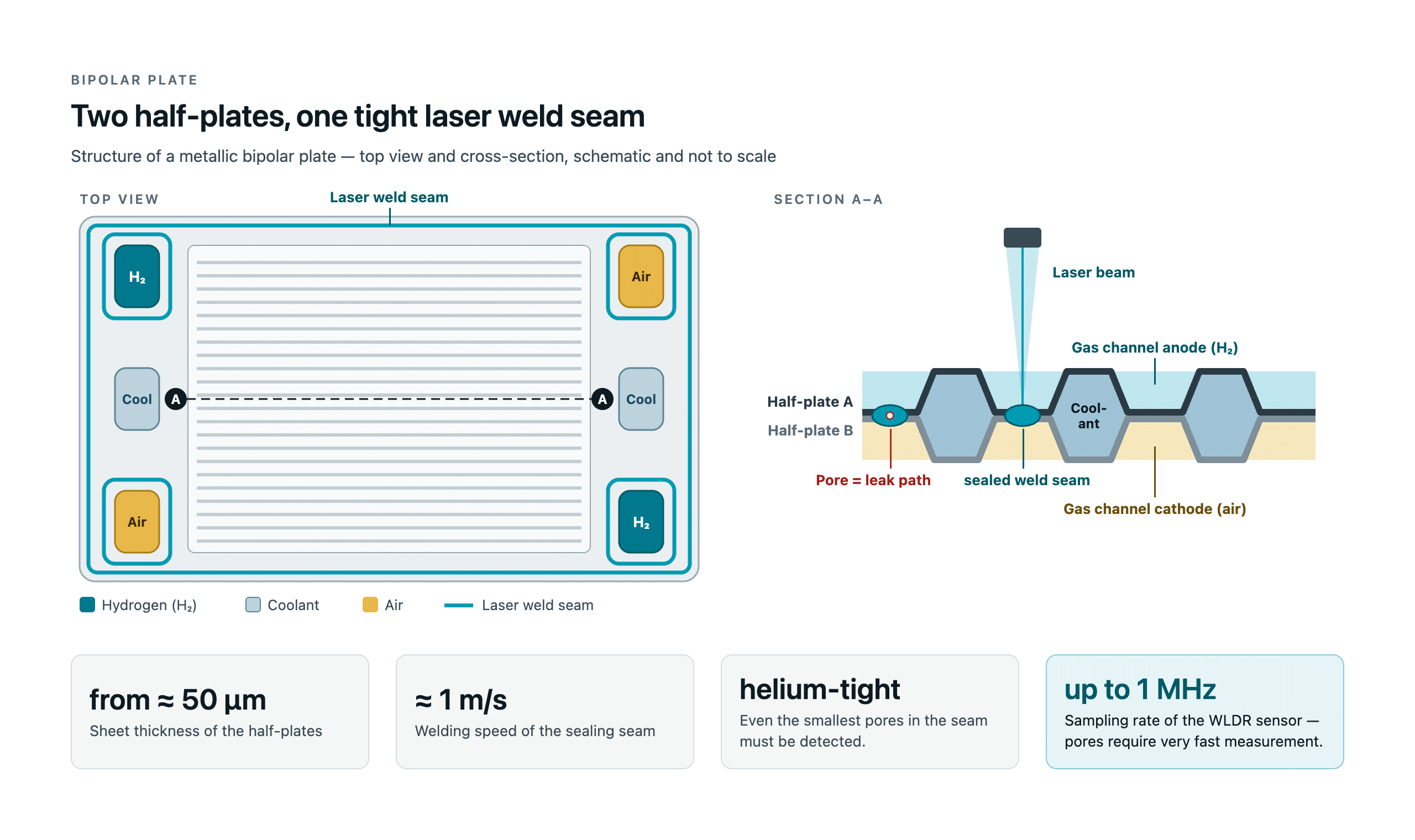
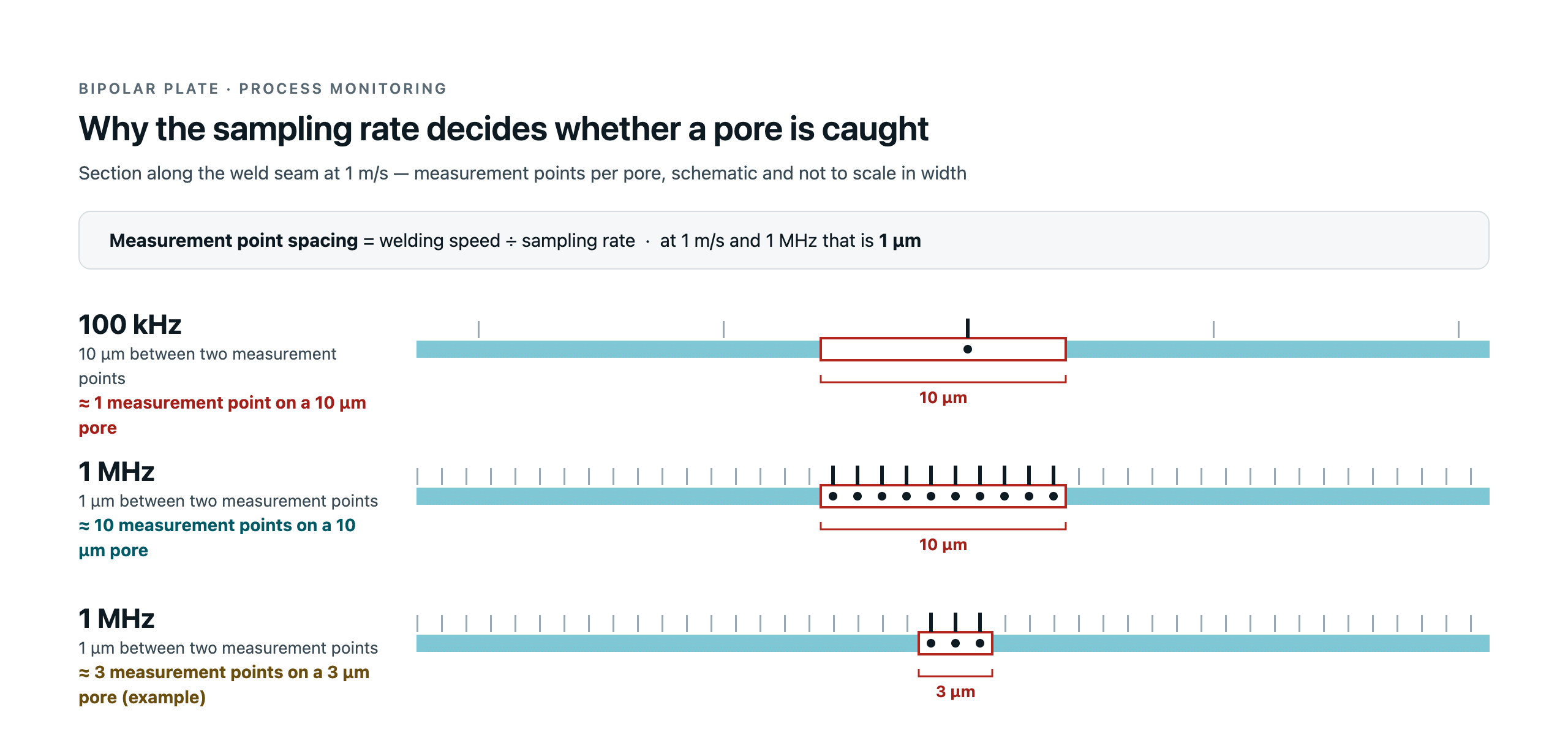
Bipolar plates for fuel cells represent one of the most challenging welding tasks of all: the material is sometimes only around 50 µm thick—comparable to a sheet of paper. Two such plates, featuring fine channels, are stacked and must then be welded to form a completely helium-tight seal at a welding speed of around one meter per second.
Reliably detecting the smallest pores, in the hundredths-of-a-millimeter range, requires sensor technology with a very high sampling rate.
According to our development team's assessment, even the current sampling rate of up to 1 MHz is not yet sufficient in every instance to ensure consistently reliable detection at this speed, an area where active development is ongoing, rather than one being marketed as a problem already solved.
At the same time, it is precisely here, in the context of very fast processes, that the strength of our sensor approach is particularly relevant. In-depth information on fuel cells and hydrogen can be found on the Renewable Energy industry page.
Risks
Needs and Risks in E-Mobility
Typical requirements and risks in e-mobility manufacturing:
Serial production capability during ramp-up
Processes must run stably, even as variants, new materials, and equipment conditions continue to evolve.
Traceability and auditability
Evidence should be available on a component-specific and consistent basis, without manual breaks in the media chain.
Quality as a safety risk
Deviations at joining points or in upstream processes can pose risks to functionality and reliability, with a corresponding potential for escalation.
Late error detection
If deviations only become apparent during final inspection or in the field, determining the root cause becomes difficult and corrective actions take longer.
Inhomogeneous data situation
Process and quality information is often distributed, across machines, lines, and IT systems, and not clearly linked.
Where we work
Where weldmetrix typically operates in the green mobility sector
In e-mobility process chains, the key leverage point often lies where quality is "created": in preparatory surface processes, in joining operations, and in verifiable release.
Pre-treatment & Surface
Joining / Welding
Process window monitoring, early detection of drift/deviations, component-specific documentation.
Quality & Traceability
Linking of the process base, order/program, and inspection results for audits and root cause analysis.
Operations & Data Sovereignty
Integration into shop-floor environments, including on-premises options if required.
What PROMOS delivers
An evaluated, documented process foundation
- Component-level traceability (process ↔ component ↔ order/program)
- Standardized documentation for quality management, audits, and customer requirements
- Structured data provision for internal quality loops and, where relevant, requirements aligned with product passports.
Regarding regulation: EU Battery Regulation (EU) 2023/1542 mandates labeling requirements starting in 2026 and a battery passport accessible via QR code starting in 2027.
PROMOS — Traceability & Documentation
Next Steps
Request a Pilot / Assessment
For a specific e-mobility use case, whether line, cell, or component family, we jointly determine which process steps are critical, which data basis is appropriate, and how to consistently structure the evidence.
No obligation, no sales pressure. If it’s not a good fit, we’ll tell you so honestly.
 English
  German